
“Do I need permits for a flip?” The answer is a resounding yes. Now more than ever before they are integral to your sanity and your flip’s legal and financial well-being. If you want to hit the moving target of profit…you want permits.
Pulling permits when doing flips is the way to go. While counter intuitive to the idea of saving every dollar, and a do-it-yourself approach we aspire to, the downsides to un-permitted work are HUGE. Read about the “why’s” and “woes” in this article before you lift that hammer!
No matter how modest your flip…even if it’s a simple one man (or one woman) project, you need to pull permits. In addition to keeping you on the right side of the law, we care a lot about maximizing profits, and permits are (ironically) the way to do just that. 
You Will Get Caught
This is the first and most obvious issue. The odds of this are not all that astronomical. A full-blown flip is a loud, messy place. Dumpsters come and go. You or your crew are working long days sometimes deep into the night.
Neighbors face dust and noise all day long…and they don’t like it. Frustration may very well take the form of someone calling your local authorities to complain…and now you have a problem.
The permit police is only the first of the headaches. There are more, and like most everything in this business it comes down to dollars and cents.
Getting It…Wrong.
Time is money as we all know. You will initially save some short money by skipping the permitting process since there is no review by an inspector…nor any delay while you wait for him or her to schedule a visit. But the savings are minimal…a day or two? Maybe a week? And what are we giving up for this? Quite a bit.
Your local building inspector is a wealth of knowledge and most are happy to help. They really are. They can advise you on mistakes during their walk-through. Rather than guessing if this is the way the pros do it, you’ll KNOW this is the right way to do it because an inspector has advised you. In addition, code changes for a reason – namely:
(1) Safety Considerations (2) Homeowner Convenience

For instance, the National Electrical Code requires outlets to be within a certain distance from a room entrance and from each outlet thereafter. In addition, even a very short wall usually requires at least one outlet to be legal.
Kitchen outlets must utilize a heavier wire gauge than required in the rest of the house. In addition, dedicated circuits here are a must. And some locales will require licensed electricians to do all this work.
The rules sound like a pain until an appliance can’t be plugged in or breakers pop because of overloads. Suddenly you wonder how you ever survived without all those outlets or circuit loading appliances.
The cost of doing this additional work is minimal from a materials perspective. But if it’s permitted, you know it will be done safely, and done right…because it must meet code. And if code requires a pro, then you want to know up front to build it into the budget. 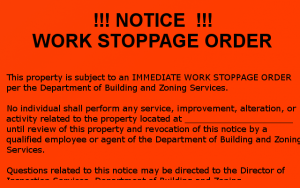
Saving Time & Money
As alluded to above, we don’t just pull permits because it is the right thing to do, we do so to protect our investment. Avoiding the permitting process not only risks doing the job wrong, it risks having to do the job again.
Your entire project timeline may be impacted should things really go south. That means more mortgage payments…and maybe even missing the selling season.
The orange stickers on the front of homes issuing “Work Stoppages” are an all too common sight. That is a REAL cost to our investor. Now he or she must re-do the work, using the correct techniques and tradespeople.

Some people take this to an extreme. It does not pay to follow their example. (“Brand New House Demolished”).
Phantom Improvements
If it isn’t permitted, vital improvement to a home, such as that additional bedroom or bath will be missing from official property records.
That means your hard work WON’T appear on the APPRAISAL record for tax authorities – which helps your pricing model. Nor in the real estate LISTING (based on official records) to avoid claims of seller falsification.
Still doubt if you need permits in a flip?
Here is another “gotcha”. Our investor has zigged and zagged to avoid the permitting process. He finishes his flip without consequence and it all looks beautiful. But now he goes to sell, and the unforeseen rises up.
The buyer agent is asking about permits. What work do they cover? Were they all closed out? If not, why and when will they be? Always assume a future buyer will inquire about permitted improvements.

Proof of permitted work is becoming a norm in some real estate transactions. Sellers may even need to attest “all work was permitted” in the property transfer’s legal documents to get the deal done.
Avoiding permits jeopardizes profit for a fairly small return. So next time someone asks you…”Do I need to pull permits for a flip?“, now you will know. Tell them yes!
Be self-reliant…but pull permits! Enough said.
Read the rest of our articles HERE. Or read a brief blurb about our books HERE.